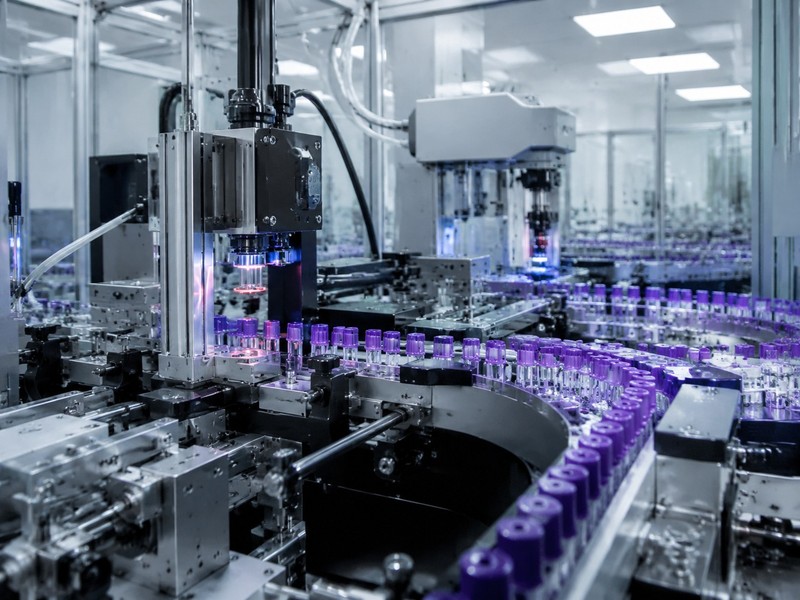
Blood Tube Manufacturing Systems in the United States
Blood collection tube manufacturing systems help medical device companies produce large volumes of consistent, sterile, and regulation-ready blood collection tubes for hospitals, diagnostic laboratories, and reference testing networks across the United States. In practice, these systems combine tube forming or feeding, additive dosing, stopper assembly, vacuum control, labeling, inspection, packaging, and data-driven quality assurance into one integrated production flow. For U.S. buyers, the main value lies in scalable automation, lower contamination risk, tighter process validation, and reliable output that aligns with FDA expectations, ISO requirements, and modern laboratory demand.
As blood testing volumes continue to rise in major healthcare markets such as New York, Chicago, Houston, Los Angeles, Atlanta, and Miami, tube manufacturers are under pressure to improve throughput while maintaining product integrity. Blood collection tubes are a critical diagnostic consumable, and even small deviations in dimensions, vacuum level, additive fill, closure performance, or labeling can affect downstream laboratory results. That is why more U.S. manufacturers are moving from fragmented manual assembly lines to fully integrated blood collection tube manufacturing systems designed for repeatability, traceability, and long-term operational control.
For companies evaluating new capacity, supplier selection matters. An experienced engineering partner can reduce commissioning delays, support validation, and align machinery design with the needs of local cleanroom layouts, utility conditions, shipping schedules, and regulatory documentation. Companies such as IVEN Pharmatech Engineering are active in this space with integrated engineering experience spanning pharmaceutical and medical device production lines, including vacuum blood collection tube equipment for global projects.
Quick Answer: Blood Collection Tube Manufacturing Systems for High-Volume, Quality-Controlled Production

A modern blood collection tube manufacturing system is an automated or semi-automated production line used to manufacture vacuum or non-vacuum blood collection tubes with high consistency. The system typically includes plastic tube forming or tube loading, cleaning, additive preparation and filling, drying or coating steps when required, butyl or rubber stopper insertion, vacuum generation, cap assembly, leak detection, online vision inspection, label application, tray or carton packing, and batch data recording.
In the United States, these systems are important for medical device companies supplying acute care hospitals, physician office labs, independent diagnostic chains, blood centers, and contract packaging operations. The biggest advantages are productivity, lower labor dependence, stronger batch traceability, and a better foundation for validation under cGMP-oriented quality systems.
| Production Need | Manual Method | Automated System Response | U.S. Market Benefit |
|---|---|---|---|
| High throughput | Limited by labor and shift variability | Continuous line operation with synchronized stations | Supports growing demand from hospital networks |
| Vacuum consistency | Hard to maintain lot-to-lot | Controlled vacuum setting and inline testing | Improves specimen collection reliability |
| Additive accuracy | Risk of dosing variation | Precision metering and automated monitoring | Better test performance and fewer rejects |
| Traceability | Paper-based records common | Electronic batch and process logging | Useful for audits and complaint handling |
| Labor efficiency | High staffing requirement | Reduced operator intervention | Helps address labor cost pressure |
| Quality inspection | Sampling-heavy, subjective | 100% vision and leak inspection options | Lower recall and nonconformance risk |
The table above shows why automated blood collection tube manufacturing systems are now preferred by U.S. medical consumables producers. They address the same issues procurement and quality teams raise most often: speed, consistency, compliance, and operational resilience.
What Is a Blood Collection Tube Manufacturing System and How Does It Work?

A blood collection tube manufacturing system is a specialized production platform for making diagnostic blood collection tubes, especially vacuum blood collection tubes used in venous blood sampling. Depending on plant configuration, the process may start with PET or glass tube preparation, or with preformed tubes entering the line for washing, coating, additive filling, and assembly.
The process normally follows a step-by-step sequence:
- Tube feeding and orientation
- Cleaning or particle removal
- Inner surface treatment if required
- Additive preparation and precise dispensing
- Drying or curing for selected reagents
- Stopper insertion and cap placement
- Vacuum generation and sealing
- Leak test and dimensional inspection
- Labeling and code printing
- Packing, case loading, and pallet preparation
For common U.S. product lines, additives may include EDTA, sodium citrate, heparin, clot activator, fluoride/oxalate, gel separator systems, or plain serum formats. Each formulation requires controlled handling because additive uniformity directly influences laboratory performance. A production line supplying customers in Boston, Philadelphia, or San Diego must deliver the same lot consistency as one shipping through distribution centers near Newark, Savannah, or the Port of Los Angeles.
Technologically, advanced systems use servo-driven indexing, PLC control, recipe management, machine vision, reject segregation, and electronic production records. This is where a supplier’s engineering depth matters. IVEN Pharmatech Engineering, for example, is known for integrating pharmaceutical-grade automation logic and compliance-oriented design into medical consumables equipment, which is attractive to manufacturers that want stronger process control rather than stand-alone machinery.
| Process Stage | Main Function | Critical Quality Point | Typical Control Tool |
|---|---|---|---|
| Tube loading | Feeds tubes in correct orientation | No deformation or jams | Automatic unscrambler and sensors |
| Cleaning | Removes particles and residues | Low particulate burden | Air rinse or dedicated cleaning station |
| Additive filling | Dispenses reagent into each tube | Volume accuracy | Precision pump or dosing unit |
| Drying/coating | Stabilizes additives | Uniform coating or dryness | Temperature and dwell-time control |
| Stoppering/vacuuming | Creates final closure and vacuum state | Seal integrity and vacuum retention | Vacuum chamber and insertion control |
| Inspection/packing | Verifies quality and prepares shipment | Defect removal and traceability | Vision system and code printer |
This workflow is why U.S. buyers usually evaluate the entire line architecture rather than a single machine. Weakness in one stage can undermine the final product, especially when serving laboratories that process thousands of specimens per day.
Key Applications and Production Benefits for Medical Device Companies

Blood collection tube manufacturing systems serve a broad range of end users. These include large diagnostic consumable manufacturers, diversified medical device firms, contract manufacturers, OEM suppliers, and investors building new plants for the North American market. Demand is driven by routine chemistry testing, hematology, coagulation studies, molecular diagnostics, emergency care, oncology monitoring, and outpatient testing growth.
In the United States, major demand clusters are tied to dense healthcare corridors. The Northeast benefits from concentration around New Jersey, Pennsylvania, and Massachusetts. The South sees strong movement through Texas, Georgia, and Florida. The West Coast remains important due to California’s hospital systems and logistics access through Long Beach and Oakland. Companies with efficient production lines can supply these regions faster and with more consistent inventory turns.
Production benefits include:
- Higher units per shift with fewer operators
- Lower contamination and handling risk
- Better additive consistency and vacuum stability
- Stronger batch traceability for complaint investigations
- Faster scale-up when adding new product SKUs
- Improved packaging uniformity for distributor channels
The chart above illustrates realistic demand weighting across key U.S. buyer segments. Hospitals and reference labs remain the strongest consumption channels, which is why line reliability and delivery continuity are critical. For manufacturers entering this market, line flexibility matters as much as speed. A facility may need to switch between serum, EDTA, citrate, and glucose tubes while keeping downtime low.
| Industry Segment | Typical Tube Types | Core Requirement | Why Automation Helps |
|---|---|---|---|
| Hospital systems | Serum, EDTA, heparin | High order reliability | Supports volume and consistent lot quality |
| Reference laboratories | Broad mixed SKU range | Standardized specimen collection | Improves tube-to-tube uniformity |
| Cancer and specialty clinics | EDTA, plasma prep tubes | Sensitive analyte handling | Better additive precision and traceability |
| Coagulation testing providers | Sodium citrate | Accurate fill ratio | Reduces dosing and vacuum deviation |
| Public health and screening programs | High-volume routine formats | Budget efficiency | Lowers cost per unit at scale |
| Contract OEM suppliers | Private-label mixed portfolio | Fast changeover and documentation | Supports multi-client production control |
This table shows that different customer groups have different priorities, but all benefit from controlled and documented production. Companies that plan to supply multiple verticals should prioritize a flexible, recipe-based line design.
Main Types and Configurations Available Today
Blood collection tube manufacturing systems are available in several configurations, depending on plant size, target output, material choice, and product mix. The most common distinction is between semi-automatic lines and fully automatic lines. There are also differences in tube material, additive technology, packaging level, and degree of digital integration.
Main configurations in the United States market include compact entry-level lines for regional suppliers, mid-capacity integrated lines for growing medical device manufacturers, and high-capacity turnkey systems for national-scale consumables production. Some plants prefer modular expansion so they can add downstream inspection or packaging later. Others want a turnkey approach that includes utilities, cleanroom planning, validation support, and staff training.
From a manufacturing capability standpoint, this is an area where IVEN Pharmatech Engineering stands out. The company operates multiple specialized manufacturing plants in Shanghai focused on pharmaceutical and medical equipment categories, including vacuum blood collection tube production equipment. That structure allows it to support both stand-alone machinery and broader factory integration for customers building complete medical consumables operations.
| Configuration Type | Best For | Output Profile | Main Advantage |
|---|---|---|---|
| Semi-automatic line | Smaller production batches | Low to medium | Lower initial cost |
| Fully automatic standard line | Established manufacturers | Medium to high | Balanced ROI and quality control |
| High-speed integrated line | National supply programs | Very high | Best throughput and lowest labor per unit |
| Modular line | Phased investment projects | Scalable | Easier expansion over time |
| Turnkey plant solution | Greenfield facilities | Project-specific | Unified engineering and validation path |
| Private-label OEM line | Multi-brand suppliers | Flexible mixed SKUs | Fast recipe change and packaging variation |
When comparing options, buyers should look beyond speed claims. A line that runs slightly slower but offers better vacuum retention, gentler stopper handling, easier cleaning validation, and stronger service support may generate better long-term economics.
Blood Collection Tube Manufacturing Systems vs Manual Assembly Lines: Key Differences and Advantages
Manual assembly lines may still exist for niche or low-volume operations, but they are increasingly difficult to justify in the U.S. market. Labor costs, traceability expectations, documentation requirements, and customer quality standards all favor automated production. Manual lines can work for pilot batches or specialized products, but their variability becomes a barrier when output expands.
The biggest differences are repeatability, labor dependence, process visibility, and compliance readiness. Automated systems also support more stable OEE performance and make it easier to implement CAPA improvements because production data is easier to analyze.
| Factor | Automated System | Manual Line | Practical Impact |
|---|---|---|---|
| Output stability | High and measurable | Operator-dependent | Automation reduces lot variability |
| Labor intensity | Lower | Higher | Important in high-wage regions |
| Quality data | Digital and trackable | Often partial | Faster investigations and audits |
| Contamination risk | Lower handling exposure | Higher touchpoints | Better product protection |
| Scale-up potential | Strong | Limited | Supports national distribution growth |
| Validation readiness | Better suited | More difficult to standardize | Easier compliance documentation |
The comparison shows why automation is increasingly the default choice. Even where initial capital is higher, U.S. manufacturers often recover the investment through labor savings, higher sellable yield, and fewer quality deviations.
Market Growth and Opportunities for Manufacturers
The U.S. blood collection tube market continues to benefit from aging demographics, broader preventive testing, chronic disease monitoring, decentralized care models, and diagnostic innovation. The manufacturing equipment side of the market grows in response to replacement demand, capacity expansion, reshoring interest, and the need for upgraded compliance systems.
Several opportunities are especially relevant through 2026 and beyond:
- Capacity expansion near East Coast and Gulf logistics hubs
- Rebuilding domestic resilience after global supply disruptions
- Higher demand for automated inspection and digital traceability
- Increased interest in energy-efficient and waste-reducing lines
- Growth of OEM and private-label consumables supply
- Policy emphasis on reliable healthcare supply chains
The line chart indicates a realistic growth trajectory for blood collection tube manufacturing equipment demand in the United States. Growth is not only volume-driven; it is also quality-driven. Many manufacturers already have production assets, but they are upgrading for better automation, electronic records, vision inspection, and reduced operator intervention.
The area chart reflects a long-term shift from legacy and labor-heavy production methods toward more automated formats. By 2026, sustainability and compliance will shape purchasing decisions even more strongly. Buyers will favor systems with lower compressed air waste, reduced reject generation, better recipe control, and easier integration into MES or ERP environments.
For U.S. plants seeking outside engineering support, turnkey project expertise is valuable. Companies can explore integrated project approaches through turnkey engineering solutions when planning new facilities or line expansions.
How to Choose a Reliable Manufacturer or Supplier
Choosing a reliable blood collection tube manufacturing system supplier requires more than reviewing a brochure. U.S. buyers should evaluate engineering maturity, documentation standards, regulatory familiarity, installed base, spare parts strategy, and the supplier’s ability to support FAT, SAT, IQ, OQ, and PQ-aligned activities where applicable.
Key evaluation questions include:
- Does the supplier understand U.S. FDA-oriented documentation expectations?
- Can the line handle your target tube sizes, additives, and packaging formats?
- Are machine contact materials robust and suitable for long service life?
- Is there evidence of stable performance in real production environments?
- How strong is training, remote support, and spare parts planning?
- Can the supplier support cleanroom layout, utilities, and validation?
Service capability is often the deciding factor after technical review. IVEN Pharmatech Engineering emphasizes full lifecycle support, from feasibility consulting and engineering design to equipment customization, installation, commissioning, validation assistance, documentation, staff training, and after-sales support. For U.S. investors who want to avoid project fragmentation, this type of service model can reduce interface risk between equipment supply and plant startup.
| Selection Criterion | Why It Matters | What to Verify | Warning Sign |
|---|---|---|---|
| Regulatory understanding | Supports compliant implementation | Document samples and validation scope | Generic or incomplete documentation |
| Technical fit | Avoids performance mismatch | Tube sizes, additives, speed, layout | Unclear process boundaries |
| Manufacturing quality | Influences uptime and longevity | Materials, machining, assembly standards | Overpromised output without proof |
| Service network | Reduces downtime risk | Response time and spare parts plan | No structured after-sales program |
| References | Shows real execution capability | Installed lines and project history | No customer examples |
| Integration ability | Important for new plants | Utilities, packaging, logistics interfaces | Only stand-alone machine focus |
Reliable suppliers should also be transparent about performance windows, not just ideal-speed claims. A credible partner will explain how output changes by tube type, additive recipe, ambient conditions, and packaging configuration.
Investment Cost, Budget Planning and ROI Analysis
The cost of a blood collection tube manufacturing system in the United States depends on automation level, output, number of SKUs, validation scope, cleanroom integration, and downstream packaging complexity. Entry-level semi-automatic systems may suit a regional or pilot-scale operation, while large fully integrated lines require significantly higher capital but deliver stronger cost per tube at scale.
Budget planning should include more than equipment price. Buyers often underestimate utilities, room preparation, HVAC balancing, qualification, local installation services, training, spare parts, and buffer inventory for startup. Imported equipment may also involve port handling, inland transportation, customs brokerage, and schedule contingencies through gateways such as Los Angeles, Houston, Savannah, or New York/New Jersey.
| Budget Element | Low Complexity Project | Higher Complexity Project | Comment |
|---|---|---|---|
| Main equipment | Moderate | High | Depends on automation and speed |
| Installation and commissioning | Moderate | High | More interfaces increase cost |
| Validation/documentation | Low to moderate | High | Critical for regulated operations |
| Utilities and room adaptation | Moderate | High | Includes power, air, HVAC, layout changes |
| Training and startup support | Low | Moderate | Reduces early operational risk |
| Spare parts and service reserve | Low to moderate | Moderate | Important for uptime planning |
ROI is usually driven by five variables: throughput, yield, labor reduction, quality loss reduction, and market access. A company moving from manual production to an automated line may improve annual output, reduce rejected batches, and shorten order lead times enough to recover investment in a commercially reasonable period. The strongest ROI cases are typically seen when demand is stable and product mix is standardized.
If you are comparing configurations, reviewing available equipment categories at the product catalog can help define the right technical scope before requesting a formal quotation.
Key Considerations and Potential Risks When Investing
Investing in blood collection tube manufacturing systems can create strong strategic value, but there are risks that must be managed early. The most common issue is under-specifying the project. A line may look cost-effective initially yet fail to support the required additive range, validation format, packaging style, or future expansion path.
Other frequent risks include inaccurate demand forecasting, weak facility preparation, insufficient operator training, and poor spare parts planning. For imported systems, communication speed and on-site support planning are also important. The best mitigation strategy is structured project management with clear URS documents, FAT criteria, acceptance parameters, and timeline control.
Technology trends through 2026 are changing risk profiles as well. Buyers should consider smart sensors for predictive maintenance, energy-efficient drives, lower-waste design, and compatibility with digital production systems. Sustainability is becoming more relevant in procurement decisions, especially for companies supplying healthcare networks with ESG reporting goals.
Policy trends may also shape plant investment. In the United States, there is continued interest in supply chain resilience, domestic manufacturing depth, and robust quality systems for critical healthcare consumables. That does not necessarily mean every line must be built domestically, but it does mean suppliers must support reliable qualification, documentation, and ongoing service.
From a technological capability perspective, IVEN Pharmatech Engineering brings value because it combines machinery development with broader pharmaceutical engineering experience and compliance awareness. Its background in regulated production environments, automation systems, water treatment, packaging, and logistics can help buyers thinking beyond a single machine purchase toward a more integrated factory strategy.
For direct project discussion, specification exchange, or quotation planning, manufacturers can use the company’s contact page to connect with the engineering team.
FAQ
1. What materials are commonly used for blood collection tubes?
PET plastic and glass are the most common materials. PET is widely used due to lighter weight, good clarity, and logistics efficiency, while glass may still be selected for some specialty applications.
2. What makes a vacuum blood collection tube different?
A vacuum blood collection tube contains a pre-set negative pressure that draws a specific blood volume during collection. Manufacturing therefore requires accurate vacuum generation, sealing integrity, and stability testing.
3. Which U.S. regulations matter most when buying production equipment?
Buyers typically focus on FDA-related quality expectations, cGMP-oriented practices where relevant, ISO quality system alignment, material suitability, traceability, and validation documentation for the production process.
4. How important is additive dosing accuracy?
It is critical. Incorrect additive volume or poor coating uniformity can affect specimen quality, analytical performance, and end-user confidence. Precision dosing and reliable monitoring are therefore core line functions.
5. Can one line produce multiple tube types?
Yes, many modern systems are designed for multiple SKUs, including serum, EDTA, citrate, and heparin tubes. However, actual flexibility depends on change parts, recipe control, cleaning procedures, and packaging design.
6. Is a turnkey approach better than buying separate machines?
For greenfield projects or large expansions, turnkey execution often reduces interface risk and simplifies scheduling, utilities coordination, validation planning, and staff training. Separate machines may work for smaller phased projects.
7. How long does installation and startup usually take?
It varies by line complexity, facility readiness, import timing, and validation scope. A fully integrated project takes longer than stand-alone equipment installation, especially when cleanroom adaptation and documentation review are included.
8. What should be included in supplier after-sales support?
Remote troubleshooting, spare parts planning, operator and maintenance training, commissioning support, documentation, calibration guidance, and upgrade pathways are all important for long-term uptime.
9. Why are internal inspection systems so valuable?
Inline vision, leak testing, and code verification reduce the chance of shipping defective product. They also improve traceability and provide data that can support continuous improvement and complaint investigations.
10. What trends will shape equipment purchases in 2026?
Expect stronger demand for smarter automation, predictive maintenance, better digital traceability, lower-energy systems, cleaner additive handling, and equipment that supports both compliance and sustainability goals.
In summary, blood collection tube manufacturing systems are now a strategic asset for U.S. medical device companies that need dependable volume, strong quality control, and scalable production economics. The best results come from choosing a supplier that offers not only equipment, but also engineering depth, manufacturing consistency, and service support throughout the full project lifecycle.

About the Author
We are IVEN Pharmatech Engineering, a team dedicated to delivering turnkey pharmaceutical and medical solutions worldwide. With decades of experience, we specialize in advanced machinery, integrated factory design, and full lifecycle support to help our clients achieve efficient, compliant, and high-quality production.
Share
Related Insights
-
United States Turnkey Injectable Pharma Plants Guide
For pharmaceutical investors, CDMOs, hospital supply manufacturers, and sterile drug companies in the United States, a turnkey pharma plant for injectable drugs is often the fastest route from concept to commercial production. Instead of coordinating civil works, cleanroom engineering, utilities, aseptic processing equipment, validation, and compliance documentation through many separate contractors, buyers can assign one integrated partner to manage the full project. This approach reduces interface risk, shortens the startup timeline, improves accountability, and supports alignment with FDA cGMP, EU GMP, WHO GMP, and PIC/S expectations. In major U.S. pharmaceutical hubs such as New Jersey, Boston, Raleigh-Durham, Houston, and San Diego, the demand for ready-to-execute sterile manufacturing projects continues to rise as companies seek resilient domestic supply chains and quicker capacity expansion.
In practical terms, turnkey injectable drug facilities are especially attractive when the product portfolio includes vials, ampoules, prefilled syringes, IV solutions, biologics support fluids, ophthalmics, or other sterile liquid dosage forms. These projects typically combine process design, clean utilities, filling and sealing lines, HVAC, environmental monitoring, automation, commissioning, validation, training, and post-handover support into one coordinated package. For U.S. buyers importing equipment through gateways such as the Port of Los Angeles, Port of Long Beach, Port of Houston, Savannah, or New York/New Jersey, an experienced turnkey partner can also simplify logistics planning, customs preparation, and phased installation.
Companies exploring integrated project delivery often compare specialist suppliers with broad engineering capabilities. One example is IVEN Pharmatech Engineering, an international pharmaceutical engineering company with long experience in sterile manufacturing systems, water treatment, filling lines, logistics integration, and complete plant execution. Its work across multiple regulated markets has made it relevant to U.S. customers seeking a partner that understands both process equipment and the wider facility environment required for injectable production.
Many large pharmaceutical manufacturers choose turnkey injectable drug plant solutions because they need speed, risk control, and compliance certainty. In the United States, sterile manufacturing projects face strict scrutiny in facility design, contamination control strategy, utility qualification, electronic records, process validation, and operator training. Managing all of these workstreams internally can be difficult unless the owner already has an experienced capital projects team with deep aseptic expertise.
A turnkey model gives the owner one main point of responsibility. That can be decisive when building a greenfield plant in Texas, expanding a sterile suite in New Jersey, or retrofitting a biologics support area in Massachusetts. Instead of resolving disputes between cleanroom contractors, equipment vendors, automation firms, and utility designers, the buyer works through one lead contractor with a unified schedule and document structure. This reduces rework and helps avoid costly delays during FAT, SAT, IQ, OQ, and PQ phases.
Another reason for demand is labor and knowledge concentration. U.S. sterile manufacturing talent is expensive and not always easy to secure, especially in competitive regions like Philadelphia, Indianapolis, or the Bay Area. A turnkey partner brings project managers, process engineers, clean utility specialists, mechanical and electrical teams, validation experts, and training personnel into one framework. That helps owners focus on product strategy, regulatory submissions, and commercial launch planning.
Key DriverWhy It Matters in the United StatesOperational EffectTypical BenefitRegulatory pressureFDA inspections require robust contamination control and documentationStandardized design and validation packagesLower compliance riskFaster launch timingInjectable shortages create urgent market opportunitiesCompressed project coordinationEarlier revenue generationHigh labor costsSkilled engineering labor is expensive in major pharma regionsExternal integrated expertiseReduced internal project burdenSupply chain resilienceDomestic capacity has become a strategic priorityQuicker local manufacturing setupImproved availabilityMulti-vendor riskSeparate contractors often create gaps in responsibilitySingle-point accountabilityFewer interface failuresValidation complexitySterile systems require detailed IQ/OQ/PQ and utilities qualificationIntegrated documentation flowSmoother startupThe table above shows why the turnkey route is increasingly favored for sterile expansion projects. For many U.S. investors, the value is not just in buying equipment; it is in buying execution certainty.
var ctxLine = document.getElementById(‘lineChartMarketGrowth’).getContext(‘2d’);var chartLine = new Chart(ctxLine, { type: ‘line’, data: { labels: [‘2021’, ‘2022’, ‘2023’, ‘2024’, ‘2025’, ‘2026’], datasets: [{ label: ‘U.S. Sterile Turnkey Project Demand Index’, data: [72, 78, 85, 93, 102, 114], borderColor: ‘rgb(54, 162, 235)’, backgroundColor: ‘rgba(54, 162, 235, 0.15)’, fill: false, tension: 0.3 }] }, options: { responsive: true, maintainAspectRatio: false }});A turnkey pharma plant for injectable drugs is a complete sterile manufacturing solution delivered from planning through operational readiness. While project scope varies, the full package usually includes feasibility analysis, process layout, cleanroom architecture, HVAC, purified water and WFI systems, pure steam, compressed gases, formulation systems, washing, depyrogenation, filling, stoppering, capping, visual inspection, labeling, packaging, warehousing, automation, and validation support.
For a vial line in the United States, a turnkey solution may start with production forecasting and the definition of target batch sizes. The next steps include material and personnel flow design, classification of cleanroom zones, utility load calculations, equipment selection, and digital integration. Depending on the dosage form, the package may also include lyophilization interfaces, restricted access barrier systems, isolators, in-line weight checking, container closure integrity solutions, and serialization-ready secondary packaging.
One area U.S. buyers should examine closely is documentation depth. A strong turnkey supplier does not stop at delivering machinery. It also delivers P&IDs, layout drawings, URS support, DQ inputs, FAT protocols, SAT records, as-built documents, SOP recommendations, maintenance plans, spare parts lists, and training records. These items significantly influence how quickly the site can move toward qualification and routine production.
System ElementTypical ContentImportance for InjectablesOwner Question to AskProcess designCapacity planning, batch logic, product flowPrevents bottlenecks and contamination riskIs the line sized for future scale-up?Cleanroom packageLayouts, partitions, pressure cascades, finishesSupports aseptic controlHow is zoning aligned with FDA expectations?Utility systemsPW, WFI, pure steam, HVAC, gasesCritical to sterile reliabilityWhat redundancy is built in?Core equipmentWashing, filling, sealing, inspection, packagingDrives throughput and product qualityWhat formats can the line run?AutomationSCADA, PLC, alarms, recipe control, data loggingImproves consistency and traceabilityCan it integrate with plant MES or ERP?Validation packageProtocols, records, test support, traceabilityAccelerates qualificationWhat is included versus owner responsibility?The table highlights a practical buying principle: turnkey scope must be defined in writing, line by line. Scope clarity matters more than headline pricing because omissions in utilities, automation, or validation can be very expensive after installation begins.
When reviewing equipment capability, many U.S. companies look for suppliers that can cover more than one sterile packaging format. IVEN, for example, is known for integrated solutions across IV solution production lines, ampoule and vial washing-filling-sealing lines, oral liquid systems, dialysis solution lines, and prefilled syringe lines. That breadth can be useful when a buyer expects future platform expansion rather than a single-format facility.
The strategic benefit of a turnkey injectable plant extends beyond engineering convenience. It can change the economics and timing of market entry. In the United States, where contract manufacturing slots for sterile products are often tight, owning a validated line creates commercial leverage. It supports supply assurance, margin retention, and long-term portfolio control.
For new facilities, the biggest gain is schedule compression. Parallel engineering, procurement, and installation planning can begin much earlier when one lead supplier controls interfaces. Instead of waiting for one contractor to finish before the next can start, the project team coordinates civil readiness, utility skid arrival, equipment FAT timing, and qualification documents in a shared timeline.
The second gain is design consistency. Sterile projects fail when utilities, room classifications, operator flows, and equipment footprints are developed in isolation. A turnkey approach encourages system-level thinking. This is especially important in U.S. projects where future FDA inspections will evaluate the total contamination control strategy, not just isolated equipment performance.
The third gain is budget predictability. While no capital project is risk-free, integrated responsibility usually reduces change orders caused by scope gaps between multiple contractors. For investors and private equity-backed pharmaceutical platforms, that visibility matters when capital deployment milestones are tied to launch objectives.
Strategic BenefitImpact on Greenfield ProjectsImpact on Expansion ProjectsLong-Term ValueFaster executionEarlier start of utility and line installationReduced shutdown overlapQuicker commercial supplyIntegrated complianceDesign aligned from day oneBetter retrofit compatibilityStronger inspection readinessLower coordination burdenOwner team stays leanerSimpler contractor managementLower management overheadBetter lifecycle planningRoom for scale-up can be built inUpgrades are easier to mapHigher asset flexibilityImproved accountabilityClear responsibility at each milestoneFewer disputes over defectsFaster issue resolutionTraining continuityOperators learn directly on supplied systemsMaintenance teams receive system-level guidanceReduced ramp-up errorsThis framework is particularly relevant for U.S. projects serving hospital injectables, generic sterile drugs, infusion products, and specialty therapies. In these segments, delayed plant readiness can mean lost contracts, stockout exposure, and slower entry into group purchasing channels.
Not every turnkey pharmaceutical plant has the same scope. In the United States, buyers generally choose among several models depending on internal capability, financing structure, and the complexity of the product pipeline. Understanding these models helps prevent overbuying or under-scoping a project.
The first model is equipment-centered turnkey delivery. This usually covers the process line, utility skids, installation supervision, and startup support. It is common when the owner already has a facility shell or a preferred local construction partner. The second model is process-plus-facility turnkey delivery, where the supplier handles cleanroom design, utilities, and equipment integration. The third model is near-EPC execution, with broad responsibility for engineering, procurement, installation coordination, qualification support, and sometimes full documentation architecture.
There are also modular project options. U.S. manufacturers under schedule pressure may choose skidded utility modules, modular cleanrooms, or phased line installations that allow one product to launch while later capacity is still under construction. This can be effective in regions with long permitting cycles or high construction costs.
Project ModelBest FitWhat Is Usually IncludedMain Trade-OffEquipment turnkeyOwners with strong in-house engineering teamsProcess line, FAT, startup, trainingOwner manages facility integrationUtility + process turnkeyMid-size sterile expansionsWater systems, HVAC coordination, line equipmentCivil scope may remain separateFull facility turnkeyGreenfield sterile plantsDesign, cleanrooms, utilities, equipment, validation supportHigher upfront commitmentModular turnkeyFast-track or capacity bridge projectsPrefabricated units and rapid install packagesLayout flexibility can be narrowerPhased turnkeyCompanies launching in stagesCore line now, later utilities or packaging expansionRequires careful master planningHybrid owner-led turnkeyBuyers wanting cost control with expert integrationShared responsibilities under a lead integratorNeeds very clear contract boundariesThe right model depends on owner maturity. A company with a seasoned capital team in Chicago or New Jersey may select a hybrid approach. A first-time sterile entrant in Arizona or Florida may benefit more from a broader turnkey package with stronger supplier accountability.
var ctxBar = document.getElementById(‘barChartIndustryDemand’).getContext(‘2d’);var chartBar = new Chart(ctxBar, { type: ‘bar’, data: { labels: [‘Hospital Injectables’, ‘Generic Steriles’, ‘Biotech Support Fluids’, ‘Ophthalmics’, ‘CDMO Capacity’, ‘Infusion Products’], datasets: [{ label: ‘2025 U.S. Demand Index’, data: [92, 88, 74, 63, 85, 79], backgroundColor: [‘rgb(255, 99, 132)’, ‘rgb(255, 159, 64)’, ‘rgb(255, 205, 86)’, ‘rgb(75, 192, 192)’, ‘rgb(54, 162, 235)’, ‘rgb(153, 102, 255)’] }] }, options: { responsive: true, maintainAspectRatio: false }});Many U.S. pharmaceutical companies ask whether they should build internally or select a turnkey supplier. The answer depends on scale, technical depth, and urgency. An in-house build can provide maximum design control and may fit organizations with large engineering departments. However, it also transfers nearly all execution risk to the owner.
Turnkey delivery excels when time to market matters, when sterile expertise is limited, or when management wants a more predictable project structure. The downside is that supplier selection becomes mission-critical. A poor turnkey partner can create the same problems as multiple weak contractors, only concentrated under one contract. That is why due diligence on capability, references, and documentation quality is essential.
For U.S. buyers, local construction and utility code coordination should also be reviewed carefully. Even when a global supplier provides a strong process package, there may still be owner-side responsibilities related to site permits, local trade coordination, seismic requirements, environmental approvals, and utility tie-ins.
Evaluation PointTurnkey ApproachIn-House BuildPreferred WhenProject speedUsually faster through integrated planningCan be slower with many contractsLaunch timing is urgentControl over designShared with supplierMaximum owner controlOwner has deep sterile expertiseInternal staffing needLowerHigherOwner team is leanCompliance supportOften stronger if supplier is experiencedDepends on owner capabilitiesFirst-time sterile projectsBudget certaintyOften better if scope is well definedCan vary with change ordersCapex discipline is importantSupplier dependenceHigher dependence on one partnerLower dependence, higher coordination burdenOwner wants single accountabilityThe comparison shows that neither model is always best. But for injectable production in the United States, where compliance, timing, and quality cannot be compromised, turnkey projects are often more practical for new entrants and mid-market expansion programs.
The market for turnkey pharma plant injectable drug projects in the United States is being driven by several structural forces. First is the continuing concern over sterile drug shortages. Health systems and regulators increasingly want a stronger domestic base for essential injectables. Second is the expansion of CDMO capacity as outsourcing remains attractive for biotech and specialty pharma companies. Third is the push toward manufacturing modernization, including automation, digital batch records, robotics, and data-integrated utilities.
Geographically, demand is concentrated in established pharmaceutical and life science corridors. New Jersey and Pennsylvania remain important for sterile drug and packaging operations. Massachusetts continues to support high-value biotech-adjacent manufacturing. North Carolina is strong for bioprocessing and fill-finish support. Texas offers scale, logistics advantages, and construction momentum. Indiana remains relevant due to its long-standing pharmaceutical base. Access to ports, interstate freight, and airport cargo routes also influences equipment import and installation planning.
By 2026, buyers are expected to place more emphasis on sustainability and digital readiness. This includes energy-efficient HVAC, water recovery strategies, heat integration, predictive maintenance, remote diagnostics, cybersecurity for automation systems, and flexible facility designs that can accommodate multi-product sterile use. Policy pressure may also encourage more resilient domestic supply chains for critical medicines.
Another trend is the move from isolated equipment purchasing to integrated lifecycle solutions. U.S. owners increasingly want vendors that can support not only manufacturing equipment but also water systems, intelligent material handling, and post-startup optimization. This wider systems approach helps reduce hidden inefficiencies after handover.
var ctxArea = document.getElementById(‘areaChartTrendShift’).getContext(‘2d’);var chartArea = new Chart(ctxArea, { type: ‘line’, data: { labels: [‘2021’, ‘2022’, ‘2023’, ‘2024’, ‘2025’, ‘2026’], datasets: [{ label: ‘Share of Projects Requesting High Automation’, data: [34, 39, 46, 54, 63, 72], borderColor: ‘rgb(75, 192, 192)’, backgroundColor: ‘rgba(75, 192, 192, 0.25)’, fill: true, tension: 0.25 }] }, options: { responsive: true, maintainAspectRatio: false }});From a strategic perspective, the market is shifting away from lowest-price procurement toward lowest total risk procurement. That is an important distinction. A low equipment quote can become expensive if startup delays, noncompliance issues, or poor utility integration add months of lost production time.
Choosing the right supplier is the most important decision in a turnkey sterile project. U.S. buyers should assess both technical competence and execution discipline. A capable supplier must demonstrate experience with aseptic processing, clean utilities, quality documentation, and cross-border delivery. It must also show that it can adapt to local U.S. requirements, owner standards, and inspection expectations.
Start with reference projects. Ask for facilities similar in scale and dosage form, especially vial filling, ampoule lines, prefilled syringes, or IV solution plants. Review not only equipment output but also startup timelines, deviation handling, spare parts response, and validation support quality. If possible, speak with existing users.
Next, assess technological capabilities. Look for robust filling and packaging equipment, water treatment systems, solution preparation and distribution systems, and smart logistics integration where needed. Suppliers with a broad engineering base are often better at solving line-to-facility interface problems. IVEN, for instance, combines sterile production equipment with pharmaceutical water treatment, intelligent conveying, and logistics systems, which can be valuable for integrated plant planning.
Manufacturing capability also matters. Buyers should ask where equipment is fabricated, how quality is controlled, what fabrication standards are used for stainless steel systems, and how spare parts continuity is managed. A supplier with multiple specialized manufacturing sites and a strong installed base is often better positioned to maintain consistency and delivery reliability.
Service capability is equally critical. U.S. projects need commissioning support, FAT and SAT coordination, validation documentation, training, after-sales response, and sometimes process optimization after commercial startup. A supplier that can provide lifecycle services from feasibility and design through commissioning and production support can reduce ownership risk significantly. You can review broader turnkey service scope at integrated pharmaceutical turnkey solutions.
Supplier Evaluation CriterionWhat to VerifyWhy It MattersEvidence to RequestRegulatory understandingKnowledge of FDA cGMP and global GMP frameworksEssential for compliant designValidation examples and compliance documentationSterile project referencesSimilar injectable installationsReduces learning-curve riskProject lists and customer casesTechnology depthLines, water systems, automation, logisticsImproves integration qualityTechnical brochures and FAT recordsManufacturing strengthFactories, QA controls, capacity, patentsSupports reliable equipment outputFactory audits and QA proceduresService responsivenessCommissioning, training, spare parts, remote supportCritical during startup and operationsService SLAs and team structureCommercial clarityDefined scope, exclusions, warranties, scheduleAvoids costly disputesDetailed proposal matrixFor buyers that want to compare available systems, a practical next step is to review the supplier’s equipment range through its pharmaceutical equipment portfolio and then request a project-specific gap analysis.
var ctxComp = document.getElementById(‘comparisonChartSupplier’).getContext(‘2d’);var chartComp = new Chart(ctxComp, { type: ‘bar’, data: { labels: [‘Compliance Support’, ‘Equipment Breadth’, ‘Utility Integration’, ‘Validation Support’, ‘Lifecycle Service’, ‘Scalability’], datasets: [{ label: ‘Integrated Turnkey Supplier Score’, data: [90, 88, 91, 86, 89, 84], backgroundColor: ‘rgb(153, 102, 255)’ },{ label: ‘Single-Equipment Vendor Score’, data: [58, 46, 39, 42, 50, 44], backgroundColor: ‘rgb(201, 203, 207)’ }] }, options: { responsive: true, maintainAspectRatio: false }});Investment cost for a turnkey injectable plant in the United States varies widely depending on dosage form, annual capacity, containment requirements, automation level, utility redundancy, and local construction cost. A smaller sterile line integrated into an existing building may require a moderate investment, while a full greenfield aseptic facility with WFI, high-grade cleanrooms, isolator technology, visual inspection, and packaging can require major capital.
Budget planning should separate at least six categories: process equipment, clean utilities, facility and cleanroom construction, automation and digital systems, validation and documentation, and contingency. It is also important to account for import logistics, inland transport, rigging, site readiness, local trade labor, taxes where applicable, and training. In U.S. projects, underestimating commissioning and qualification resources is a common mistake.
ROI depends on much more than capex. It is influenced by utilization rate, product mix, gross margin, batch success rate, labor productivity, maintenance cost, and time to regulatory readiness. If a turnkey supplier shortens the startup schedule by six to nine months, the resulting revenue acceleration can outweigh a higher initial project price.
Cost CategoryTypical Share of BudgetMain VariablesControl StrategyProcess equipment20% to 30%Formats, speed, aseptic technologyMatch capacity to realistic demandUtilities12% to 20%WFI, PW, steam, gases, redundancyRight-size loads and future expansionCleanrooms and facility works25% to 35%Layout, finishes, local labor ratesOptimize room classification and flowAutomation and data systems8% to 15%SCADA, integration, cybersecurityDefine digital architecture earlyValidation and quality documentation5% to 10%Protocol depth, owner standardsClarify deliverables in contractContingency and startup reserve8% to 12%Change orders, schedule risksMaintain realistic reserve fundingThe table above is useful for concept-stage planning because it prevents overfocus on the line price alone. In sterile projects, utilities and qualification often carry as much strategic importance as the filler itself.
For ROI analysis, U.S. companies often build three scenarios: conservative, target, and high-utilization. Conservative assumptions might include gradual ramp-up, one or two major products, and moderate line efficiency. The target case assumes normal validation timing and stable customer demand. The high-utilization case includes additional shifts, portfolio broadening, or contract manufacturing revenues.
A sensible financial model should also price the value of reduced project risk. If an integrated supplier helps avoid contamination-related redesign, delayed qualification, or utility mismatch, that risk reduction has real financial value. Companies seeking a tailored budget discussion or concept review can contact a turnkey project specialist for a preliminary consultation.
Although turnkey injectable projects offer major benefits, buyers should approach them with disciplined risk management. The first major risk is unclear scope. If the contract does not specify responsibilities for cleanroom finishes, BMS interfaces, utility distribution loops, FAT acceptance criteria, or validation deliverables, disputes can delay startup. A scope matrix with included, excluded, and owner-supplied items is essential.
The second risk is underestimating local U.S. implementation requirements. Even an excellent global turnkey supplier may need support from local architects, MEP firms, code consultants, and installation teams familiar with U.S. standards. The owner should define early how responsibilities will be shared.
The third risk is capacity overdesign. Some investors buy more speed and more room classification than the product pipeline justifies. That can hurt ROI through higher maintenance, greater environmental control costs, and more complex operations. The plant should be designed for practical growth, not theoretical maximums.
The fourth risk is insufficient lifecycle planning. Sterile plants need ongoing calibration, utility sanitization strategies, spare parts planning, operator retraining, and change control support. A turnkey project should transition smoothly into sustainable operations.
Risk AreaTypical ProblemPotential ConsequenceMitigation ActionScope gapsUnclear inclusions and exclusionsCost overruns and delaysDetailed contract scope matrixRegulatory mismatchDesign not aligned with inspection expectationsRework during qualificationEarly compliance review and DQ inputSite readinessBuilding or utility prep behind scheduleInstallation idle timeIntegrated master scheduleOvercomplex designToo much automation or unnecessary capacityHigher capex and opexDemand-based engineering decisionsWeak trainingOperators not prepared for aseptic disciplineStartup deviationsStructured training and SOP alignmentAfter-sales limitationsSlow support or spare parts responseLonger downtimeService agreement and parts planningLooking ahead to 2026, the most successful projects in the United States will likely combine compliance, flexibility, and sustainability. Owners should ask whether the proposed plant supports lower water and energy usage, digital maintenance visibility, flexible container formats, and future automation upgrades. Designs that can adapt to changing product demand will age better than rigid single-purpose facilities.
What products can a turnkey injectable pharma plant manufacture?Depending on the line configuration, it can produce small-volume parenterals in vials or ampoules, large-volume infusions, prefilled syringes, sterile oral liquids, dialysis solutions, and other aseptic liquid products.
Is a turnkey solution suitable for the United States market?Yes, if the supplier can align design and documentation with FDA cGMP expectations and coordinate effectively with local U.S. site requirements, codes, and qualification practices.
How long does a turnkey injectable project usually take?The timeline depends on scope, but concept design through qualification can range from around 12 months for limited expansions to 24 months or more for full greenfield sterile plants.
What is the biggest advantage over buying separate equipment?The biggest advantage is integration. Utilities, cleanrooms, process equipment, automation, and validation are planned together, reducing interface failures and shortening startup time.
What should be included in supplier validation support?At minimum, buyers should look for FAT protocols and records, SAT support, IQ/OQ document packages or templates, calibration records, material certificates, manuals, and traceable as-built documentation.
Can a turnkey plant be expanded later?Yes. Good master planning allows future filling speeds, secondary packaging lines, additional utility generation, extra warehouse space, or new product rooms to be added with less disruption.
How important are pharmaceutical water systems in injectable plants?They are critical. Purified water, WFI, pure steam, and distribution loops are foundational to injectable quality. Buyers should evaluate design hygiene, automation, sanitization strategy, and documentation carefully.
Why consider a supplier with integrated engineering depth?Because injectable projects are not just about a filler. Strong partners can coordinate process technology, water treatment, conveying, packaging, and facility interfaces in one system, improving overall reliability.
What distinguishes a company like IVEN for this type of project?Its relevance comes from combining technological capabilities in sterile production lines and water systems, manufacturing capabilities across specialized equipment plants, and service capabilities that extend from feasibility and design to commissioning, validation support, training, and optimization. For U.S. buyers, that combination can help reduce execution risk on complex injectable projects.
How should a buyer start?Start with a process and business definition: target products, annual output, container types, regulatory pathway, and preferred location. Then request a concept proposal, layout, utility estimate, and scope matrix from a qualified supplier before moving into detailed budgeting.
For investors, project owners, and pharmaceutical operations teams in the United States, the best turnkey injectable plant decision is rarely the cheapest bid. It is the solution that combines compliant engineering, realistic throughput, dependable utility design, robust documentation, and strong service support over the full asset life. With sterile demand growing and 2026 trends pointing toward more automation, sustainability, and domestic capacity resilience, an integrated turnkey model remains one of the most practical ways to build high-quality injectable manufacturing capability.
-
United States Guide to Pharmaceutical Water Systems
For pharmaceutical manufacturers in the United States, a pharmaceutical grade water system is not a simple utility package. It is a validated production-critical system that directly affects product quality, microbial control, compliance, uptime, and operating cost. Whether a facility is producing injectables in New Jersey, oral solids in Chicago, biologics in Boston, or medical consumables in Texas, the right purified water, water for injection, and clean steam solution must be selected based on regulation, process use, expansion plans, and lifecycle service support. This guide is written for B2B buyers, engineering teams, procurement managers, and investors evaluating new installations, line expansions, and turnkey sourcing options.
In practical terms, buyers in the United States usually compare four paths: a local skid supplier, a local integrator using imported components, a global engineering company with U.S. compliance experience, or a China-based manufacturer that can provide a customized system together with documentation, FAT, SAT, commissioning, validation support, and long-term parts supply. The best decision depends on the application, not just the quoted price.
A pharmaceutical grade water system is designed to generate, store, circulate, and distribute water that meets defined pharmacopeial and plant process requirements. In the United States market, the selection process typically starts with the end product category: sterile injectables, oral liquids, solid dosage, biologics, dialysis solution, or medical device manufacturing. From there, engineering teams define the required water grades, daily consumption, peak demand, sanitization method, loop temperature, instrumentation, and compliance package.
U.S. facilities usually evaluate systems according to USP expectations, FDA cGMP alignment, risk management, and documented qualification practices. Buyers also want resilience against raw water variability, especially in regions where municipal source quality fluctuates. For example, facilities near Houston may face different incoming water profiles than plants in California or the Mid-Atlantic. A robust design often combines pretreatment, reverse osmosis, electrodeionization, ultrafiltration, storage and distribution loops, plus optional distillation and pure steam generation.
From a procurement perspective, the most successful projects start with a user requirement specification, then move to process design review, utility balancing, layout confirmation, FAT, shipment planning, site installation, IQ/OQ support, and training. Buyers looking for turnkey execution can review integrated pharmaceutical turnkey capabilities early in the project, especially if the water system must connect with formulation, CIP/SIP, filling, and clean utility infrastructure.
var ctxLine = document.getElementById(‘lineChart’).getContext(‘2d’); var lineChart = new Chart(ctxLine, { type: ‘line’, data: { labels: [‘2021’, ‘2022’, ‘2023’, ‘2024’, ‘2025’, ‘2026’], datasets: [{ label: ‘Estimated U.S. Demand Index for Pharma Water Systems’, data: [72, 78, 86, 94, 103, 114], borderColor: ‘rgb(54, 162, 235)’, backgroundColor: ‘rgba(54, 162, 235, 0.15)’, fill: false, tension: 0.3 }] }, options: { responsive: true, maintainAspectRatio: false } });The chart above reflects the broad growth pattern seen in U.S. demand for pharmaceutical water systems, driven by sterile manufacturing investment, biologics expansion, and facility modernization through 2026.
Common B2B Evaluation Factors for U.S. Buyers Factor Why It Matters Typical U.S. Buyer Concern Preferred Evidence Water Grade Defines process suitability USP-compliant design basis P&ID and design dossier Microbial Control Reduces contamination risk Loop sanitization strategy Sanitization SOP and data Validation Support Accelerates startup Qualification burden on site team IQ/OQ templates and FAT records Material Selection Protects water quality 316L finish and weld quality MTRs and passivation records Automation Improves consistency Alarm history and traceability HMI/PLC functional description Lifecycle Service Minimizes downtime Spare parts and remote support Service plan and response modelThis table shows why the lowest capital quote rarely wins in serious pharmaceutical procurement. Documentation quality, loop design, and service depth often determine the true project value.
A supplier solution is more than a piece of equipment. It is the full engineering and delivery scope that turns raw feed water into validated pharmaceutical water at the point of use. A complete solution usually includes pretreatment, generation skids, storage tanks, distribution loops, instrumentation, controls, heat exchangers, sanitization functionality, documentation, FAT, installation guidance, and qualification support.
For B2B buyers in the United States, the most useful supplier solutions are those that can be tailored to facility reality. A CDMO in Philadelphia may need a flexible modular unit for multi-product campaigns, while a high-volume injectable plant in North Carolina may require a larger hot WFI loop with pure steam integration and future expansion ports. The supplier should therefore deliver not only hardware, but also application engineering.
A mature supplier solution generally covers the following areas:
Buyers seeking a system partner rather than a single machine vendor often prefer companies that combine equipment manufacturing with process engineering. IVEN Pharmatech Engineering, for example, operates as a pharmaceutical engineering partner with experience in water treatment systems, filling lines, logistics systems, and broader plant integration. This matters when the water system must align with filling, formulation, and packaging operations instead of functioning as an isolated utility package.
The most common system categories in pharmaceutical production are purified water systems, water for injection systems, purified steam systems, and complete storage and distribution loops. Each type serves a different risk profile and process purpose.
Main Pharmaceutical Water System Types and Specifications System Type Typical Use Core Technologies Key Controls Common Materials Typical Capacity Range Pretreatment System Protects downstream membranes and distillers Sand filter, carbon filter, softener, dosing SDI, hardness, chlorine control FRP, SS304, SS316L 500 L/h to 50,000 L/h Purified Water System Oral solids, oral liquids, equipment cleaning RO, EDI, UF, UV Conductivity, TOC, flow, pressure SS316L product-contact surfaces 300 L/h to 30,000 L/h Water for Injection System Sterile products and high-risk processes Multi-effect distillation or vapor compression Conductivity, endotoxin control, temperature Electropolished SS316L 100 L/h to 10,000 L/h Purified Steam Generator SIP, humidification, sterile contact use Clean steam generation Pressure, dryness, non-condensable gases SS316L 50 kg/h to 3,000 kg/h Storage Tank and Loop Maintains water quality to point of use Sanitary tank, pump, heat exchanger, UV Recirculation velocity, temperature, bioburden SS316L with orbital welds 500 L to 20,000 L tank sizes Integrated Utility Skid Compact modular installations Combined pretreatment, generation, and controls PLC recipes, alarms, trending Mixed sanitary construction Project-specificThe table above helps U.S. buyers map system type to process need. In most projects, the real discussion is not whether to buy “a water system,” but which combination of technologies best fits the product and validation strategy.
Typical core specifications include feed water quality, design temperature, loop velocity, instrument brand preferences, calibration plan, sanitary welding standards, drainability, dead-leg limits, passivation, and cybersecurity expectations for automation. For facilities subject to frequent audits, documentation readiness is nearly as important as hardware quality.
When reviewing product portfolios, buyers can compare available configurations and utility packages through a supplier equipment catalog and solution overview, but a project-specific technical review is still essential because water systems are rarely true off-the-shelf products.
var ctxComp = document.getElementById(‘comparisonChart’).getContext(‘2d’); var comparisonChart = new Chart(ctxComp, { type: ‘bar’, data: { labels: [‘Compliance Readiness’, ‘Customization’, ‘CapEx Efficiency’, ‘Lead Time Control’, ‘Lifecycle Integration’, ‘Documentation Depth’], datasets: [ { label: ‘Generic Utility Supplier’, data: [72, 60, 68, 65, 55, 62], backgroundColor: ‘rgba(255, 99, 132, 0.7)’ }, { label: ‘Pharma-Focused Engineering Supplier’, data: [92, 88, 83, 80, 91, 90], backgroundColor: ‘rgba(153, 102, 255, 0.7)’ } ] }, options: { responsive: true, maintainAspectRatio: false } });This comparison chart illustrates why pharma-focused suppliers generally score better in validation and integration, even if initial quotations appear more detailed or higher.
Pharmaceutical grade water supports both direct and indirect production functions. In sterile manufacturing, WFI may be used for formulation, rinsing of critical components, and equipment preparation. In non-sterile operations, purified water commonly supports solution preparation, cleaning, and selected process steps where chemical and microbial control are required.
Key Applications Across Pharma Production Application Area Typical Water Grade Risk Level Why It Matters Injectable formulation WFI Very high Direct product contact in sterile dosage forms Vial and ampoule final rinse WFI Very high Controls endotoxin and contamination before filling Oral liquid preparation Purified Water Medium Supports product consistency and microbial control Tablet coating and granulation Purified Water Medium Affects product quality and process repeatability CIP feed for process equipment Purified Water or WFI Medium to high Reduces residues and supports validated cleaning Clean steam generation support Purified Water or WFI feed High Enables SIP and sterile utility performanceThe application table shows how the same site may require multiple water grades. This is common in U.S. multi-product plants, especially among CDMOs and biologics facilities.
In biologics production, water quality consistency is especially important for upstream media prep, buffer preparation, and equipment cleaning. In medical consumables and related clean manufacturing, purified water may be used for washing, component preparation, or support functions that still require documented quality control.
As facilities move toward continuous improvement and data-rich operations, many buyers also request online conductivity, TOC, temperature, and flow monitoring with alarm history and trend reporting. This supports deviation investigation and preventive maintenance.
The buyer base for pharmaceutical grade water systems in the United States is broad. It extends beyond branded drug manufacturers to include CDMOs, biotech firms, sterile solution producers, medical consumables plants, research and pilot facilities, and expansion-stage investors building GMP infrastructure.
Typical U.S. Buyer Segments Buyer Segment Main Need Preferred System Profile Decision Driver Sterile injectable manufacturers WFI, pure steam, validated loops High-reliability hot systems Compliance and uptime CDMOs Flexible multi-product use Modular scalable systems Changeover efficiency Oral dosage plants Purified water for production and cleaning RO/EDI-based solutions Cost and consistency Biologics facilities High purity with robust monitoring Integrated data-ready platforms Process sensitivity Medical device and consumables plants Controlled utility water Application-specific PW systems Product cleanliness New GMP project investors Turnkey engineering and startup support Integrated utility and plant design Project risk reductionBuyer needs vary significantly by location and business model. Facilities in Boston and San Diego often prioritize biologics compatibility and digital monitoring. Plants around New Jersey and Philadelphia may emphasize sterile production compliance, while Midwest manufacturers may focus on cost-efficient upgrades of aging utility infrastructure. Gulf Coast and Texas projects sometimes prioritize heavy-duty pretreatment because incoming water quality can vary more widely.
var ctxBar = document.getElementById(‘barChart’).getContext(‘2d’); var barChart = new Chart(ctxBar, { type: ‘bar’, data: { labels: [‘Injectables’, ‘Biologics’, ‘CDMOs’, ‘Oral Dosage’, ‘Medical Devices’, ‘Research/Pilot’], datasets: [{ label: ‘Estimated 2025 U.S. Procurement Demand Index’, data: [95, 88, 82, 64, 58, 46], backgroundColor: ‘rgba(255, 159, 64, 0.75)’ }] }, options: { responsive: true, maintainAspectRatio: false } });The bar chart reflects the strongest current demand from injectable and biologics manufacturing, which continue to drive high-spec utility investments in the United States.
The best system is chosen by process fit, not by brochure language. Buyers should begin with a clear user requirement specification that defines water grades, point-of-use demand, continuous versus batch consumption, expansion margin, sanitization philosophy, automation requirements, and required documentation deliverables.
Practical Supplier Selection Checklist Selection Area What to Check Common Risk if Ignored Best Practice Regulatory fit USP/FDA/GMP design alignment Rework during qualification Request compliance matrix Capacity design Average and peak demand sizing Short supply at production peak Add growth margin Sanitization method Hot water, ozone, chemical, or steam Microbial instability Match to operation model Loop design Velocity, slope, dead-leg control Biofilm and stagnant zones Review isometric details Documentation FAT, MTR, weld log, calibration list Delayed validation Define list in contract After-sales support Parts, remote service, on-site support Long downtime Agree SLA before orderThis checklist is useful because many system problems are not caused by the main generation technology. They come from poor loop design, incomplete documents, or weak post-installation support.
U.S. buyers should also compare domestic and overseas sourcing models objectively. Local suppliers can offer easier site access and faster communication. However, overseas manufacturers with dedicated pharmaceutical engineering teams can deliver stronger customization, better integration with upstream and downstream process equipment, and lower total project cost. The deciding factor should be whether the supplier understands pharmaceutical manufacturing, not merely water treatment.
When evaluating suppliers, ask to see examples of similar projects, especially in regulated markets. Experience with U.S.-style documentation, audit readiness, and onsite coordination is a major advantage.
Prices vary widely because system scope varies widely. A compact purified water skid for a small oral liquid facility is very different from a fully validated WFI plus purified steam package for an injectable plant. In the United States market, buyers should request budgetary ranges first, then move to detailed quotations only after confirming the technical basis.
Indicative Price, MOQ, and Lead Time Ranges System Category Indicative Price Range Typical MOQ Lead Time Main Cost Drivers Small PW skid USD 25,000-80,000 1 set 8-14 weeks Automation, instrumentation, pretreatment Medium PW system with loop USD 80,000-250,000 1 set 12-20 weeks Tank, loop piping, qualification package Large PW integrated solution USD 250,000-600,000 1 project 16-28 weeks Capacity, redundancy, site conditions WFI distillation system USD 180,000-700,000 1 set 16-30 weeks Distiller type, output, finish level Pure steam generator USD 70,000-300,000 1 set 12-24 weeks Steam load, controls, materials Turnkey water utility package USD 500,000-2,500,000+ 1 project 20-40+ weeks Engineering scope, installation, validationThese figures are indicative and should be used for budgeting only. Final pricing depends on raw water quality, utility availability, preferred component brands, tank size, loop routing, and documentation scope. Freight route can also affect landed cost. Shipments to the Port of Los Angeles, Long Beach, Savannah, or Newark may have different timing and customs handling patterns than inland project deliveries.
MOQ is usually one complete set or one project because pharmaceutical water systems are typically customized. Lead times are driven by stainless steel fabrication, instrumentation availability, FAT scheduling, and shipping. Buyers who need faster timelines should lock in URS decisions early and avoid repeated layout changes.
Sourcing from China can be a strong option for U.S. buyers when the supplier has real pharmaceutical engineering depth, export experience, and compliance-oriented project execution. The best sourcing model is not transactional; it is structured and document-driven.
A practical sourcing flow usually looks like this:
For U.S. importers, supplier location and logistics coordination matter. Manufacturers in Shanghai can ship efficiently through Shanghai Port, while some projects may source components through Ningbo or Shenzhen depending on fabrication and export planning. On the U.S. side, final destination planning should consider whether the site is near major pharma hubs such as New Jersey, Boston, Indianapolis, Raleigh-Durham, or San Diego.
When sourcing from China, buyers should focus on five risk controls: document completeness, material traceability, FAT quality, packaging for sanitary equipment, and clear service responsibilities after arrival. A credible supplier should be comfortable sharing company background through its corporate profile and engineering experience and should provide direct technical communication, not just sales language.
Another sourcing advantage is integration. If the same supplier can also support filling systems, logistics, solution preparation, or broader clean utility planning, project interfaces become easier to manage. That can reduce change orders and commissioning delays.
var ctxArea = document.getElementById(‘areaChart’).getContext(‘2d’); var areaChart = new Chart(ctxArea, { type: ‘line’, data: { labels: [‘2021’, ‘2022’, ‘2023’, ‘2024’, ‘2025’, ‘2026’], datasets: [{ label: ‘Shift Toward Modular and Digitally Monitored Systems’, data: [28, 35, 43, 52, 63, 75], fill: true, backgroundColor: ‘rgba(75, 192, 192, 0.25)’, borderColor: ‘rgb(75, 192, 192)’, tension: 0.3 }] }, options: { responsive: true, maintainAspectRatio: false } });The area chart highlights a major 2026 trend: more buyers are shifting from basic utility skids to modular, digitally monitored, and validation-friendly water systems.
Choosing a supplier is easier when capabilities are broken into three practical dimensions: technology, manufacturing, and service.
Technological capabilities: Our team focuses on pharmaceutical and medical manufacturing engineering rather than generic utility equipment alone. This allows us to match purified water, WFI, pure steam, solution preparation, and downstream production requirements within one project logic. We design systems with attention to compliance expectations, sanitary construction, control architecture, and long-term operating stability. Our engineering background also supports integrated planning for injectable plants, oral dosage facilities, biologics operations, and medical consumables projects.
Manufacturing capabilities: We operate specialized manufacturing resources in Shanghai across pharmaceutical equipment segments, including water treatment systems. This structure improves quality control, fabrication consistency, and coordination between utility and process equipment. Stainless steel construction, sanitary fabrication practice, and durable component selection are prioritized to support long equipment life and dependable operation. For buyers that need more than a standalone skid, our production and engineering structure supports broader factory utility matching and turnkey execution.
Service capabilities: We support customers through feasibility review, engineering design, customization, equipment selection, FAT, installation guidance, commissioning, IQ/OQ/PQ support, documentation, training, and after-sales response. For U.S. buyers, this means a supplier relationship that continues beyond shipment. We understand that project risk is often created by layout errors, weak coordination, uncertain quality, and delayed startup; our service model is designed to reduce those points of failure. Buyers interested in discussing a new plant, line expansion, or utility upgrade can contact our engineering team for a technical review.
Our experience in regulated-market projects is especially valuable for B2B customers seeking a partner capable of customizing equipment while maintaining engineering discipline. We also support integrated pharmaceutical factory development, which is helpful when the water system must fit into a wider project schedule rather than being treated as a separate purchase.
In addition, we bring a practical understanding of global pharmaceutical project challenges: balancing cost with compliance, managing utility interfaces, handling documentation expectations, and maintaining delivery schedules. For many U.S. buyers, that combination is more important than simply choosing the nearest vendor.
1. What water grades are most common in U.S. pharmaceutical plants? Purified Water and Water for Injection are the most common. Some plants also require purified steam and specialized distribution loops depending on the dosage form and process risk.
2. How do I know whether I need PW or WFI? The answer depends on the product and the point of use. Sterile and high-risk applications often require WFI, while many oral and cleaning applications use Purified Water. Your URS and quality team should define this early.
3. Can a supplier customize the system for existing U.S. facilities? Yes. Most retrofit projects require customization because space, utility tie-ins, ceiling heights, and loop routing differ from plant to plant.
4. What documents should be included in the purchase scope? At minimum, request P&IDs, GA drawings, component manuals, certificates, weld logs, FAT records, calibration lists, and IQ/OQ support documents. More complex projects may need full turnover packages.
5. How long does validation usually take after delivery? It depends on site readiness, protocol approval, and project complexity. Strong FAT preparation and complete documentation can shorten qualification time significantly.
6. Is sourcing from China realistic for the United States market? Yes, if the supplier has export experience, pharmaceutical engineering expertise, strong documentation control, and a clear support model after installation.
7. What are the most important 2026 trends? The main trends are higher digital visibility, modular project delivery, stronger sustainability targets, reduced water and energy consumption, and closer alignment between utility design and data integrity expectations. More buyers are also asking for systems that support predictive maintenance and lower total cost of ownership.
8. How important is sustainability in supplier selection? It is increasingly important. U.S. buyers are evaluating reject water recovery, heat recovery, lower chemical consumption, efficient pump design, and optimized sanitization strategies as part of procurement decisions.
9. Should I buy from a local supplier or an international engineering company? Choose based on project fit. Local access can be useful, but specialized pharma engineering, customization capability, and turnkey integration may create better value over the full project lifecycle.
10. What is the best first step before requesting a quote? Prepare a clear URS with feed water analysis, required water grades, peak consumption, preferred standards, installation constraints, and expected validation documents. This makes supplier quotations more accurate and comparable.
For U.S. buyers planning new facilities or modernization projects, pharmaceutical grade water systems will continue to be a strategic investment through 2026 and beyond. Strong demand from injectables, biologics, and outsourced manufacturing is pushing the market toward smarter, cleaner, and more integrated utility platforms. The right supplier should deliver more than equipment: it should deliver compliance confidence, manufacturing reliability, and a practical path from design to validated production.
-
United States Guide to Blood Tube Machine Sourcing
For United States buyers, the right blood collection tube making machine is not just a piece of factory equipment. It is a validation-sensitive production asset that directly affects tube quality, additive dosing accuracy, vacuum stability, labeling consistency, packaging speed, and ultimately regulatory readiness. A practical buying decision should balance output targets, tube formats, cleanroom requirements, automation level, after-sales support, and total cost of ownership rather than headline price alone.
Whether you are building a new medical consumables plant in Texas, expanding a diagnostics supply chain in California, or evaluating import options through Los Angeles, Long Beach, New York, Savannah, or Houston, the manufacturer you choose will influence project risk, commissioning speed, spare parts availability, and long-term return on investment. Buyers in the United States also need to think carefully about quality documentation, FAT and SAT expectations, validation support, and whether the machine supplier can align with FDA-oriented manufacturing practices.
This guide explains how B2B buyers can evaluate a blood collection tube equipment manufacturer, compare machine types and specifications, assess market demand, review customization options, and source effectively from China. It also highlights how IVEN Pharmatech Engineering supports pharmaceutical and medical device factories with integrated engineering solutions for regulated production environments.
A blood collection tube making machine manufacturer guide is a decision framework for companies purchasing equipment used to produce vacuum blood collection tubes and related medical sampling consumables. In practical terms, it helps buyers compare suppliers based on technical performance, regulatory alignment, customization depth, factory capacity, documentation quality, validation support, project management, and service responsiveness.
For United States projects, the most reliable approach is to start with five core questions:
The best manufacturers do more than sell a stand-alone machine. They help shape a full production concept, including room layout, process flow, utility matching, line balancing, and packaging integration. For buyers expanding into complete plants, this becomes especially important because the blood tube line must work seamlessly with air handling, purified water systems where applicable, logistics, inspection, and warehouse planning.
Below is a practical comparison table for evaluating manufacturers.
Evaluation Factor What to Check Why It Matters for United States Buyers Low-Risk Benchmark Regulatory understanding Ability to support GMP-oriented documentation and validation workflows Reduces qualification risk and speeds customer audits Documented FAT, manuals, protocols, traceability Process capability Additive filling accuracy, vacuum consistency, capping yield Directly impacts product quality and reject rates Stable repeatability under continuous production Customization depth Support for tube size changes, cap colors, label formats, pack styles Useful for private label, OEM, and hospital distribution contracts Modular tooling and recipe management Manufacturing strength In-house fabrication, assembly, testing, and QC Improves schedule reliability and spare parts control Dedicated workshops and documented testing Service responsiveness Remote support, commissioning, training, spare parts planning Limits downtime after import into the United States Structured after-sales team with escalation path Total cost of ownership Energy use, changeover time, maintenance intervals, consumables Affects long-term profitability more than initial purchase price Clear lifecycle cost estimateThis table matters because many buyers focus first on machine speed and quotation price, but production reliability depends just as much on engineering maturity, component quality, and service infrastructure. A slightly higher-capex system often produces lower cost per tube over five to ten years.
A manufacturer guide for this equipment category explains how suppliers design and build machines used for the automated production of vacuum blood collection tubes. These lines usually include tube feeding, cleaning or handling, additive dosing, drying or curing where needed, vacuuming, stopper insertion or capping, leak testing, labeling, tray loading, and final packaging.
The guide should also explain the difference between buying a single process module and buying a complete line. Some factories only need a semi-automatic additive dosing or capping station to increase throughput. Others require a turnkey production line with upstream and downstream integration, environmental controls, and project documentation suitable for a regulated medical consumables operation.
From a technical capability perspective, experienced suppliers are expected to offer:
In this area, IVEN Pharmatech Engineering is notable for combining pharmaceutical engineering knowledge with vacuum blood collection tube production equipment experience. Rather than operating only as a machine fabricator, the company has built its reputation around integrated factory solutions and production systems that align with international compliance expectations. Buyers exploring broader facility development can review its turnkey engineering capabilities when a simple equipment purchase is not enough.
For United States buyers, a manufacturer guide should also clarify import reality. Machines sourced from China can be highly competitive in capital efficiency, but the right partner must provide English documentation, electrical conformity planning, clear parts lists, factory test records, and practical support for startup after ocean freight arrives at ports such as Long Beach or Savannah and equipment is moved inland to installation sites.
Demand for blood collection tube making machines has expanded steadily as diagnostic testing volumes rise, outpatient care networks grow, and healthcare systems increase local manufacturing resilience. In the United States, demand is supported by hospitals, independent laboratories, public health systems, contract medical device manufacturers, and distributors seeking stable domestic or near-domestic supply.
Three market forces are especially important:
For 2026 and beyond, the market is expected to shift further toward digitalized production, lower-energy machine design, higher-speed inspection, and lines that can switch efficiently between serum, plasma, clot activator, EDTA, citrate, and specialty tube formats. Sustainability will also become a procurement factor as buyers examine compressed air consumption, reject reduction, recyclable packaging compatibility, and machine longevity.
Year Estimated Global Equipment Demand Index United States Buyer Activity Index Main Demand Driver 2022 100 100 Post-disruption capacity recovery 2023 108 111 Lab volume normalization and replacement projects 2024 117 121 Automation investment and product diversification 2025 126 132 Regional manufacturing expansion 2026 137 144 Compliance-ready intelligent production lines 2027 149 157 Digital MES integration and sustainable designThe table above is an index view rather than a fixed sales figure. It shows the direction of demand: the United States market tends to move faster than the global average because buyers place a premium on resilient supply and high-throughput automation.
var ctx1 = document.getElementById(‘marketGrowthLine’).getContext(‘2d’); var marketGrowthLine = new Chart(ctx1, { type: ‘line’, data: { labels: [‘2022’, ‘2023’, ‘2024’, ‘2025’, ‘2026’, ‘2027’], datasets: [{ label: ‘Global Equipment Demand Index’, data: [100, 108, 117, 126, 137, 149], borderColor: ‘rgb(54, 162, 235)’, backgroundColor: ‘rgba(54, 162, 235, 0.15)’, fill: false, tension: 0.3 }, { label: ‘United States Buyer Activity Index’, data: [100, 111, 121, 132, 144, 157], borderColor: ‘rgb(255, 99, 132)’, backgroundColor: ‘rgba(255, 99, 132, 0.15)’, fill: false, tension: 0.3 }] }, options: { responsive: true, maintainAspectRatio: false } });This chart highlights a practical sourcing implication: manufacturers with scalable production capacity and international project experience will be better positioned to support new United States orders without long lead time inflation.
Blood collection tube making machines can be divided by automation level, process scope, output capacity, and tube compatibility. For a buyer, the right machine type depends on planned throughput, number of SKUs, labor model, cleanroom design, and budget.
Common categories include semi-automatic units for small or pilot batches, fully automatic integrated lines for commercial mass production, and modular lines that let factories add inspection or packaging capacity later. The specification that matters most is not only tubes per hour but process stability across long production runs.
Machine Type Typical Output Best For Strengths Limitations Semi-automatic dosing and capping unit 2,000 to 4,000 tubes/hour Small factories, R&D, niche products Lower investment, simpler operation Higher labor dependence Entry-level automatic line 4,000 to 8,000 tubes/hour Growing regional suppliers Balanced cost and output Fewer advanced inspection options Mid-speed integrated line 8,000 to 12,000 tubes/hour Established OEM manufacturers Good flexibility across SKUs Requires stronger utilities and layout planning High-speed automatic line 12,000 to 18,000 tubes/hour Large-scale medical consumables plants Best labor efficiency and consistency Higher capex and validation complexity Modular line with inspection and packing Variable Factories seeking phased expansion Expandable architecture Integration planning is essential Turnkey multi-process production line Project-specific New plant builds End-to-end coordination Longer project timelineThe table helps buyers identify the correct entry point. Many United States companies overbuy on speed and underplan for SKU complexity. If frequent changeovers are expected, a slightly slower machine with faster tooling exchange and stable recipe control may deliver better annual output.
Specification Area Typical Range Questions to Ask Commercial Impact Tube diameter and length 13×75 mm, 13×100 mm, 16×100 mm and custom How many tube formats can run on one line? Determines SKU flexibility Additive filling accuracy Depends on formulation and volume What repeatability data is available? Affects product quality and compliance Vacuum control Adjustable by tube type Can vacuum levels be recipe-managed? Critical for blood draw performance Automation control PLC plus HMI, servo systems Is data logging included? Improves traceability and maintenance Changeover time From under 30 minutes to several hours Which parts require manual adjustment? Impacts uptime and labor cost Utilities Power, compressed air, cleanroom interface Can the supplier match U.S. plant utilities? Avoids installation delaysAs a rule, request a specification sheet, process flow diagram, utility matrix, spare parts list, and sample FAT checklist before comparing quotations. This makes supplier evaluations much more objective.
Choosing the right machine starts with a user requirement specification. Buyers should define annual output, tube assortment, packaging style, staffing model, validation expectations, and budget ceilings. Once this is done, supplier discussions become technical and measurable rather than promotional.
Use the following decision criteria when reviewing proposals:
Buying Criterion Why It Matters Preferred Evidence Warning Sign Output at stable quality High speed is meaningless without low reject rates Long-run test data and FAT records Quoted speed without proof Regulatory support Documentation reduces startup friction Validation package and material certificates Only basic manuals offered Tooling flexibility Supports multi-SKU production Documented change parts and recipes Extensive manual adjustments Component quality Drives machine life and maintenance costs BOM transparency and brand list Unclear sourcing of critical parts Factory acceptance testing Verifies performance before shipment Structured FAT protocol No formal FAT stage After-sales capability Protects uptime in the United States Remote support plan and spare parts package Service limited to email onlyBuyers should also compare pricing correctly. Entry quotations often exclude mold sets, change parts, conveyors, packaging modules, FAT witness travel, on-site commissioning, and extended warranties. The best sourcing practice is to ask every supplier for a like-for-like quotation matrix that lists included and excluded items.
From a technology standpoint, IVEN Pharmatech Engineering is often evaluated favorably by buyers looking for pharmaceutical-grade engineering logic in medical consumables production. Its technical strengths include experience in automated blood collection tube production platforms, integrated control systems, stainless steel equipment construction, and process-focused design shaped by work across pharmaceutical filling, packaging, water systems, and intelligent logistics. That cross-disciplinary background can be valuable for United States facilities where machine selection must fit larger factory systems rather than act as a stand-alone purchase.
For buyers ready to compare options, the company’s equipment portfolio can be used as a starting point for matching output goals to project scope.
These machines are used primarily for vacuum blood collection tube manufacturing, but their application scope is broader than many first-time buyers expect. Depending on line design, they support plain tubes, clot activator tubes, gel tubes, EDTA tubes, heparin tubes, glucose tubes, citrate tubes, ESR products, pediatric formats, and customized private-label combinations.
Applications also vary by business model. Some buyers manufacture their own branded products for domestic distribution, while others act as OEM or contract manufacturers for hospital groups, diagnostic brands, or regional medical distributors.
Application Tube/Product Type Key Process Requirement Machine Feature Needed Routine phlebotomy supply Serum and plasma tubes Stable vacuum and labeling Reliable vacuuming and labeling modules Coagulation testing Sodium citrate tubes Precise additive ratio Accurate liquid dosing system Hematology testing EDTA tubes Uniform additive deposition Controlled filling and mixing steps Chemistry testing Gel and clot activator tubes Multi-material handling Flexible dosing and curing integration Pediatric sampling Small-volume tubes Gentle handling and format precision Fine format changeover capability Private label manufacturing Custom cap and label combinations Frequent SKU switching Recipe control and quick-change toolingThis application table shows why the machine should be chosen around product mix, not only current volume. A line that cannot handle future specialty tube demand may become a bottleneck much sooner than expected.
In many modern plants, the blood tube line is integrated with upstream material handling and downstream cartoning or case packing. This is where suppliers with broader manufacturing capability become relevant. IVEN Pharmatech Engineering operates specialized manufacturing resources across pharmaceutical filling and packaging systems, water treatment systems, intelligent conveying and logistics equipment, and vacuum blood collection tube production equipment. For United States buyers planning plant-wide automation, that manufacturing breadth may simplify integration and shorten interface risk between different equipment packages.
The buyer base for this equipment extends well beyond traditional device factories. In the United States, demand comes from large healthcare suppliers, diagnostics manufacturers, contract manufacturers, lab network vendors, and investment-backed firms developing domestic medical consumables capacity.
Typical B2B customer groups include:
var ctx2 = document.getElementById(‘industryDemandBar’).getContext(‘2d’); var industryDemandBar = new Chart(ctx2, { type: ‘bar’, data: { labels: [‘Medical Consumables’, ‘Diagnostics’, ‘Contract Manufacturing’, ‘Hospital Supply’, ‘Lab Brands’, ‘Private Label Distributors’], datasets: [{ label: ‘Estimated United States Demand Share (%)’, data: [28, 22, 16, 12, 13, 9], backgroundColor: [ ‘rgba(75, 192, 192, 0.8)’, ‘rgba(54, 162, 235, 0.8)’, ‘rgba(255, 206, 86, 0.8)’, ‘rgba(255, 159, 64, 0.8)’, ‘rgba(153, 102, 255, 0.8)’, ‘rgba(255, 99, 132, 0.8)’ ] }] }, options: { responsive: true, maintainAspectRatio: false } });The chart suggests that the largest demand comes from established medical consumables and diagnostics manufacturers, but contract manufacturing and private-label distribution are growing faster. This matters because these buyers often prioritize flexibility and rapid SKU changes over maximum nominal speed.
Geographically, sourcing and deployment decisions often connect to logistics hubs. Companies importing equipment into the United States commonly route containers through Long Beach or Los Angeles for West Coast projects, Savannah for Southeast projects, Houston for Gulf Coast installations, and Newark or New York for Northeast distribution corridors. Inland commissioning can then support manufacturing zones around Chicago, Atlanta, Dallas, Raleigh, or the New Jersey life sciences cluster.
OEM and private-label production is one of the strongest reasons to invest in a modern tube production line. Buyers often need custom cap colors, branding layouts, multilingual labels, tube set combinations, tray configurations, and secondary packaging for specific hospital systems or distributor programs.
A strong machine supplier should be able to customize around three layers:
A practical OEM case can look like this: a mid-sized U.S. distributor wants to launch a private-label blood tube line serving hospitals in Florida, Georgia, and the Carolinas. The company initially forecasts 40 million tubes annually, but plans a second phase tied to regional lab contracts. In such a case, a modular line with quick changeover, strong label accuracy, and room for downstream pack automation is often better than a fixed high-speed line optimized for one SKU.
Another case: a contract medical manufacturer near Chicago needs multiple additive tube variants and customer-specific carton packs. Here, recipe management, coding accuracy, and validation support become more important than absolute maximum throughput.
Future trend data also show a shift toward intelligent customization, with buyers requesting remote diagnostics, predictive maintenance alerts, and digital production reporting.
var ctx3 = document.getElementById(‘trendShiftArea’).getContext(‘2d’); var trendShiftArea = new Chart(ctx3, { type: ‘line’, data: { labels: [‘2022’, ‘2023’, ‘2024’, ‘2025’, ‘2026’, ‘2027’], datasets: [{ label: ‘Demand for Standard Lines’, data: [68, 64, 59, 54, 49, 45], fill: true, backgroundColor: ‘rgba(54, 162, 235, 0.25)’, borderColor: ‘rgb(54, 162, 235)’, tension: 0.3 }, { label: ‘Demand for Customized Intelligent Lines’, data: [32, 36, 41, 46, 51, 55], fill: true, backgroundColor: ‘rgba(255, 99, 132, 0.25)’, borderColor: ‘rgb(255, 99, 132)’, tension: 0.3 }] }, options: { responsive: true, maintainAspectRatio: false } });The area chart indicates a clear shift: standardized equipment remains important, but customized intelligent lines are gaining share as buyers seek better lifecycle efficiency and faster response to changing clinical demand.
On the service side, IVEN Pharmatech Engineering differentiates itself through lifecycle support rather than a ship-and-forget model. Its service capabilities include feasibility support, engineering design, equipment selection, installation and commissioning, validation-oriented assistance, staff training, documentation support, and long-term optimization services. For United States importers, this is particularly valuable because smooth startup often depends on how well the supplier handles pre-shipment coordination, SAT planning, and post-install troubleshooting.
China remains a major sourcing base for blood collection tube production equipment because it combines manufacturing scale, mechanical engineering maturity, competitive pricing, and increasing export experience. However, successful sourcing requires structured due diligence.
The recommended process is as follows:
Pricing varies widely by line scope. A smaller semi-automatic unit may be budget-friendly, while a fully automatic turnkey line with advanced inspection, packing, and validation support can command a much higher investment. The true comparison should include not only base machine cost but also factory preparation, consumables, format parts, commissioning, and expected annual maintenance.
Cost Element Often Included? What United States Buyers Should Verify Potential Hidden Cost Main machine body Usually yes Confirm exact modules and throughput basis Missing process stations Format change parts Sometimes List tube sizes covered in quote Extra tooling charges FAT and testing materials Varies Clarify who provides consumables and sample tubes Unexpected FAT preparation fees Installation and commissioning Often partial Check travel days, visas, and local support responsibilities Extra on-site day rates Validation documents Sometimes limited Ask for document list upfront Costly post-order documentation add-ons Spare parts package Optional Request first-year recommended spare list Downtime due to delayed replacementsThis cost table helps prevent the most common sourcing mistake: comparing incomplete quotations as if they were equal. The lowest landed cost is often achieved by the supplier with the clearest scope, not the lowest sticker price.
When sourcing from China, manufacturing depth matters. IVEN Pharmatech Engineering has developed dedicated production capabilities through specialized plants focused on pharmaceutical and medical equipment categories, including vacuum blood collection tube production systems. That gives buyers confidence that fabrication, assembly, testing, and project coordination are supported by an established industrial base rather than outsourced ad hoc production.
If your team is preparing an RFQ or wants to discuss a United States project schedule, you can contact the engineering team for a technical exchange before finalizing the specification.
1. What is the most important specification to compare? The best starting point is stable output at target quality, not top speed alone. Compare additive filling accuracy, vacuum consistency, capping integrity, reject rate, and changeover time.
2. How much does a blood collection tube making machine cost? Pricing depends on automation level, capacity, number of SKUs, inspection scope, and packaging integration. Semi-automatic units are far less expensive than high-speed turnkey lines. Always compare full project cost, not only machine base price.
3. Can one line produce multiple tube types? Yes, many lines can handle multiple tube sizes and additives through change parts and recipe settings. Buyers should verify exactly which formats are covered and how long changeover takes.
4. Is sourcing from China suitable for United States buyers? Yes, if the supplier has export experience, strong documentation, reliable FAT practices, and structured after-sales support. Project success depends on due diligence and clear scope definition.
5. What documents should I request before ordering? Request a technical proposal, machine layout, utility requirement list, component brand list, FAT protocol, recommended spare parts list, delivery schedule, and documentation list covering operation and maintenance.
6. How long is the typical lead time? Lead time varies by machine complexity, customization level, and factory schedule. Simple configurations can move faster, while turnkey lines may require several months for design, build, FAT, shipment, and installation.
7. What should a United States buyer plan for after arrival? Plan customs clearance, inland transport, unloading, room readiness, utility connection, SAT scheduling, operator training, and initial spare parts inventory. Coordination at ports and with local rigging teams can affect startup timing.
8. Are sustainability factors becoming important? Yes. For 2026 procurement cycles, buyers increasingly ask about energy efficiency, compressed air use, equipment longevity, low-waste design, and process control that reduces rejects. These factors support both cost reduction and ESG goals.
var ctx4 = document.getElementById(‘supplierComparison’).getContext(‘2d’); var supplierComparison = new Chart(ctx4, { type: ‘bar’, data: { labels: [‘Customization’, ‘Documentation’, ‘Factory Capacity’, ‘Validation Support’, ‘Lifecycle Service’, ‘Cost Efficiency’], datasets: [{ label: ‘Integrated Engineering Supplier’, data: [92, 90, 88, 91, 94, 85], backgroundColor: ‘rgba(75, 192, 192, 0.8)’ }, { label: ‘Basic Equipment Exporter’, data: [68, 60, 70, 55, 58, 82], backgroundColor: ‘rgba(255, 99, 132, 0.8)’ }] }, options: { responsive: true, maintainAspectRatio: false } });This comparison chart illustrates a practical procurement reality. Basic exporters can appear competitive on initial price, but integrated engineering suppliers often outperform in documentation, validation support, customization, and lifecycle service. For regulated production in the United States, those strengths frequently produce better total value.
In summary, the right blood collection tube making machine manufacturer should offer more than equipment supply. The best partner combines process knowledge, manufacturing depth, project discipline, and after-sales reliability. For United States buyers, especially those building new capacity or upgrading regulated operations, it is wise to prioritize measurable technical performance, factory acceptance rigor, and long-term service structure.
Companies evaluating complete plant development or advanced medical consumables projects may also benefit from reviewing the broader background of Shanghai IVEN Pharmatech Engineering Co Ltd, whose experience in pharmaceutical and medical device engineering, specialized manufacturing resources, and integrated project support has made it a recognized partner for international production facilities. When machine selection is tied to future expansion, turnkey execution, or cross-system integration, that broader capability can materially reduce project risk.
For buyers in the United States, the most effective sourcing strategy is straightforward: define your requirements carefully, compare suppliers on lifecycle value, verify factory capability, and choose a manufacturer that can support compliance, customization, and dependable operation long after installation day.